Turkey, Vietnam and Two Very Different Roads to Mobile Gaming Success

Written by Martin Macmillan, Partner & Founder at Pollen Capital
I have spent the past few weeks on the ground in Turkey and Vietnam, meeting studio founders, investors and ad networks. Both countries are routinely described as mobile gaming powerhouses, and the usual explanation is talent and cost. The talent is undeniable. The cost argument is weaker than it looks, and in Turkey these days, it barely holds at all.
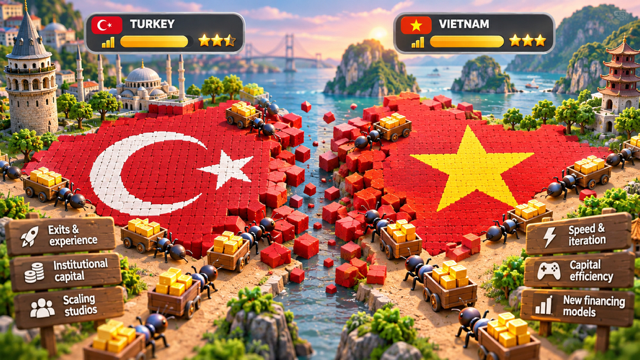
What struck me more empirically was how quickly founders in both countries seem to be learning from the successes around them. Exits create founders and precedent. Founders create capital through recycling back into their own ecosystem. Capital availability encourages ambition. Turkey is roughly a decade into that cycle. Vietnam is really just entering it but catching up very fast.
Turkey is no longer cheap
As anyone who has visited Istanbul recently will know, Turkey is far more expensive than it was even a few years ago. The same inflation visible to tourists in hotels and restaurant prices has fed straight through into domestic wages.
Mobile game developers are comparatively very well compensated due to demand, but the wider wage inflation picture helps explain the pressure on studio costs. The relevant question for a business earning in dollars is how quickly salaries rise relative to the exchange rate. When Turkish wages rise faster than the lira weakens, those costs rise in dollar terms too.
The mobile gaming halo effect adds another layer of competition for talent. Well-funded studios are chasing the same engineers, designers and product leads, and the best people command a premium. The level of talent is undeniable but any cost advantage is harder to decode, and it is not what explains Turkey’s success.
What explains it is a flywheel of experience, exits and rising ambition. Zynga’s acquisitions of Peak and a majority stake in Rollic in 2020 did more than return money to investors. They showed what Turkish studios could build, scale and sell. The talent was already spreading: Dream Games was founded by Peak alumni in 2019, before either deal. By July 2026, Royal Match had generated more than $7 billion in lifetime revenue, according to PocketGamer.biz. Experience travels from one studio to the next, and each success raises the ambition of the founders who follow.
The numbers show it. According to InvestGame, Turkish mobile studios raised roughly $400 million between January 2025 and mid-October 2026, close to 40% of the global total for private funding of mobile studios and more than either Asia-Pacific or North America. Loom Games, founded in 2025, agreed a majority sale to Scopely in February 2026 in a performance-based deal reportedly valuing the studio above $1 billion. Dream Games’ 2025 transaction paired CVC equity with debt financing from funds managed by Blackstone and other investors. These are different forms of capital, but together they show how far the market has developed.
The effect on talent may matter most. More than once I heard that top graduates from Turkey's leading universities are now seeking to join mobile gaming studios over investment banks. That only happens when an industry has a visible record of turning talent into wealth, and in a shorter timeframe than a career in investment banking.
The founder mindset has shifted too. In the Rollic era, many young studios pitched prototypes to publishers. Today every studio with any ambition wants to self-publish, because they have seen that owning your games, your players and your revenue is what creates something worth buying.
A word on incentives
Turkey’s incentives get a lot of attention, and they can be a genuine help early on. Tax relief and support for marketing and platform fees can lower the cost of experimenting, which is exactly where a young studio needs support. But these are different schemes, with different conditions and limits. They can help fund growth; they do not explain on their own why a studio succeeds.
My personal view is simple. Incentives lower the bar to entry but they do not per se help build companies. A tax break can strengthen the economics of a business, but it should not be the reason to build or locate one there. The business needs to work when the rules change.
Vietnam: speed as a strategy
Vietnam took a different route. Vietnamese mobile games recorded 4.9 billion downloads worldwide in 2025, ranking second behind China, according to GameGeek’s recent industry report. Much of that growth came from studios built without venture capital. Jennifer Vu, writing for Gamesforum in January, estimated that only 1 to 2% of Vietnamese studios had raised VC funding. She put it neatly: hypercasual chose Vietnam because the capital was absent. Small teams could ship quickly and earn their investment back fast, while publishers offered a route to funding user acquisition.
The result is a speed I have rarely seen anywhere. In hypercasual, teams learned to take a mechanic from concept to launch in weeks, then iterate relentlessly. More complex games take longer, but that habit of rapid execution remains.
The clearest illustration is playing out right now in a single genre. Pixel Flow was built in Istanbul by Loom Games, whose founders had previously made a hit for Rollic before choosing to self-publish. A team of around ten built the game in roughly three months. In February 2026, Scopely agreed to acquire a majority stake in a performance-based deal reportedly valuing the studio above $1 billion.
Colony Flow, from Hanoi-based ABI Games, part of the OneSoft group, launched in June with a similar core loop. In his analysis of the 30 days ending 27 October, Matej Lancaric reported estimated in-app purchase revenue of $12.44 million for Colony Flow against $11.92 million for Pixel Flow, with roughly 3.7 times as many downloads. One month is not a lifetime, and the genre faces disputes over alleged copying. Pixel Flow had already generated an estimated $198.4 million in gross player spending during its first year, excluding advertising. But the comparison shows how quickly a Vietnamese studio can challenge an established hit. Loom’s own rise depended on speed too; access to capital and a major buyer did not put its game beyond competition.
The self-publishing evolution
The industry is now changing shape. GameGeek’s 2025 industry report puts the share of Vietnamese studios that have moved from advertising-only models to in-app purchases or hybrid monetisation at 73%. The opportunity is to build games that keep earning long after launch, creating a back catalogue with lasting value.
The ambition to self-publish is clearly there. What holds studios back is capital and know-how, and both are fixable. Some founders still see a publisher as their best route to market, and that is a reasonable way to learn the trade. But the terms matter. A studio that retains little of the IP or control over publishing has fewer assets of its own to sell and may have fewer exit options.
Recent deals are concentrating minds. In December 2025, NCSOFT announced a deal to acquire 67% of Indygo Group, the Singapore parent of Vietnamese studio Lihuhu, for approximately $104 million. At the time, NCSOFT said Lihuhu expected roughly $81 million in revenue and $20 million in operating profit for 2025, with more than 80% of revenue coming from North America and Europe. Tellingly, Lihuhu was advised by Istanbul-based Alfa Games Partners. The Turkish playbook is being exported.
The deal also brings the question of structure into focus. Indygo’s Singapore holding company is a useful example, rather than a template every studio needs to follow. The wider lesson is to make deliberate decisions early about where IP, publishing accounts and contracts sit. Unpicking them later can complicate a financing or sale.
Does Vietnam need venture capital?
VCs are now turning up at events in Ho Chi Minh City and Hanoi, looking for the next breakout studio. For some founders, they will be valuable partners. But raising venture capital need not be the default next step for studios that have already learned to build profitable games from their own cash flow.
The constraint is already visible. More than one ad network told me the same thing: their smaller Vietnamese partners cap spend at the credit line rather than at the returns, and leave money on the table.
For studios with working games and profitable acquisition, the immediate need may be capital to fund growth rather than equity to build the company. The right cohort-financing relationship can fund new player acquisition while founders retain ownership. It will not suit every game, and the cost and terms matter. But Vietnam’s bootstrapping discipline, combined with well-matched growth finance, could be a compelling advantage: a route to scale that some studios can take without a venture round.
That route comes with conditions: reliable performance data, a sensible offshore corporate structure, and someone credible in charge of the money/metrics.
The shared blind spot
Which brings me to the gap I see across both markets: finance needs to become part of the growth strategy earlier. The question is not simply whether a studio has a CFO. It is whether someone is connecting game performance, acquisition spending and cash, and helping the founder decide what the business can afford to do next.
From a CFO’s perspective, a profitable acquisition campaign and an affordable growth plan are different things. A studio can expect an attractive return from new players and still put its cash under pressure while it waits for that return. The finance question is not just “does this cohort pay back?” It is “when does the cash arrive, what else must we fund before then, and what happens if performance falls short?”
The financing landscape is changing quickly and proving to be a great enabler for studios that would have traditionally considered external publishing as their route to market. Cohort-based UA funding can finance new player acquisition against expected future returns. Some lenders with a higher risk appetite will work with just one or two months of performance data; more conservative lenders may want six. The requirements depend on the genre, the game’s expected lifespan and how quickly acquisition spending pays back.
That is where the choice of financing matters. The right structure depends on what is being financed, how predictable those cash flows are, and when repayments fall due. The largest facility is not necessarily the best one. What matters is how much useful growth it supports, what it costs, and how much room the studio retains if a game underperforms.
A veteran gaming executive I met this week in Da Nang, who has worked with some of the largest studios, put it plainly: financial sophistication is not yet where it needs to be. My answer is not to add bureaucracy or insist that every small studio hire a full-time CFO. It is to give finance a strategic role earlier, with clear responsibility for cash forecasting, funding terms and lender obligations. UA and finance need to work together on how fast the business can grow. For founders who are already strong at building games and bootstrapping, that capability can turn good game economics into a more durable business.
Learning from their own
The most encouraging thing about both ecosystems is how fast they are learning, and from whom. Turkish founders learned from Peak, Rollic and Dream. Vietnamese founders are now learning from Lihuhu and the exits that will follow. Neither needs to import a model from Silicon Valley or London. The proof points are local, and every outcome raises the bar for the next.
Turkey has the exit culture and the capital. Vietnam has the speed, the capital efficiency and the appetite. The next generation of winners will combine those strengths with the financial discipline to turn successful games into lasting businesses.



Home of the Gamesforum events series and leading mobile game analysis. Discover everything you need to know about mobile games marketing and monetization.