Google wants everyone to make games. Should studios be worried?
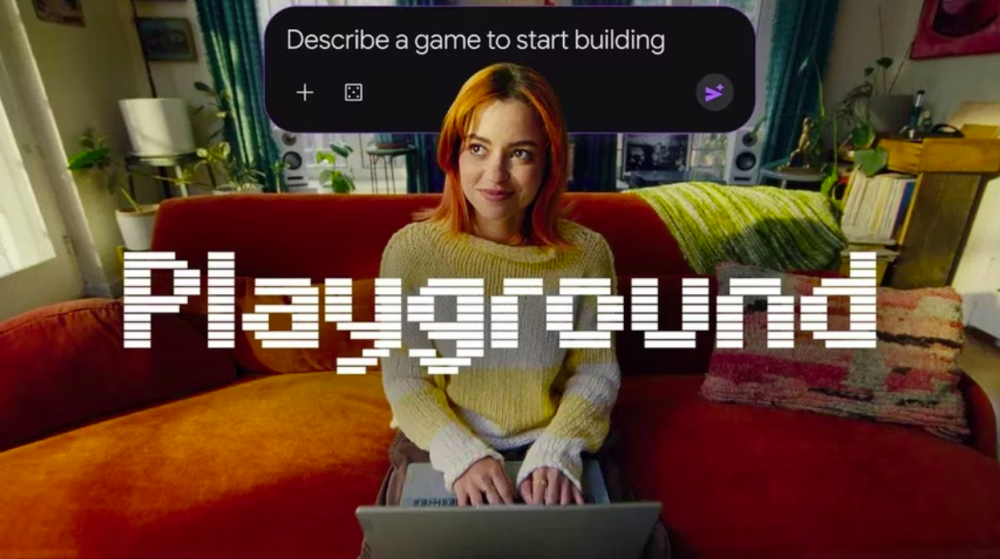
Google has announced the launch of Playground, an experimental platform for creating, playing and sharing custom games. You don't need any coding experience. You describe the game you want, test it straight away, and then keep refining the physics, rules, characters or environment by asking for changes.
Google's pitch is about access. Until now, making a game has mostly been limited to people who know complex engines, and Playground aims to open it up to everyone else.
The obvious headline is "AI makes games now." For anyone in this industry, the better question is what Google is really building and what it changes.
The creation tool is the hook. The platform is the point.
The launch post spends as much time on playing and sharing as it does on creating.
Playground has a growing catalogue of community games that run in the browser on phones and laptops. Creators can keep a game private, send a link to challenge friends, or publish it to the Playground Explore gallery. Some genres support leaderboards and multiplayer. A Play Games profile gives you a custom handle, lets you like games and climb rankings, and lets you follow creators so you see their new releases. The gallery uses player ratings and play activity to decide which games to feature.
That's not a dev tool. It's a UGC platform with discovery, social features and creator followings, and the creation tool is the way in. That puts Google squarely in the territory of the existing UGC giants. In that race, what matters is becoming the default place where casual creators make things and casual players find them, not having the best engine.
Unity's role shows where the ceiling is
Playground will soon integrate with Unity Spark, which brings professional-level mechanics, high-fidelity 3D and the Unity runtime. Spark is in testing now, with a closed beta coming soon. Games built with it will be playable by everyone on Playground.
This quietly admits that prompt-to-game gets you started but not finished. The interesting part is the funnel. Google owns the entry point and the audience, and Unity owns the upgrade path for creators who outgrow it. Google describes it as an ecosystem where you begin with a text prompt and grow into building immersive experiences. Expect more partnerships like this as platforms and tooling companies each try to own a stage of the creator journey.
What this means for studios and publishers
The most immediate change is to prototyping. Being able to play a concept as soon as you've described it changes how teams pitch, test and kill ideas, so it gets cheaper and stops being optional. Studios that treat this as a toy will fall behind the ones that use it to decide what gets greenlit.
It also means the idea itself is no longer the moat. Once anyone can turn a concept into something playable, the difference between games comes even more from execution, live ops, IP and community, which is where professional teams still win.
The guardrails are worth watching too. At launch, Playground is open to US users aged 18 and over, and how much you can create depends on your Google AI subscription tier. Every published game goes through safety screening against Google's community guidelines, and users can report games. As Google scales, the way it handles moderation, quality and creator incentives will set expectations for everyone else in this space.
Should we be sceptical?
Lowering the barrier to creation also lowers the bar for quality, and there are real reasons to be cautious. When anyone can make a game in a few prompts, most of what gets made will be rough, unfinished or abandoned after one session. Playground's gallery relies on ratings and play activity to surface the best work, but that only works if enough players are willing to wade through everything else first.
Scale brings its own sameness. If thousands of creators use the same models, starter prompts and remixes, a lot of the output will look and play alike, and real originality could get harder to spot. Perception is part of the problem too. Players are already wary of AI-generated content, and if prompt-made games get a reputation for being low-effort, that suspicion could spread to legitimate studios using AI responsibly in their own pipelines.
Then there's IP. It's easy to describe a game that's suspiciously close to an existing hit, and while safety screening and user reporting can catch harmful content, it's less clear whether they can catch every knock-off at volume. Underneath all of this is a broader worry about craft. Game design, art and engineering are hard-won skills, and tools like this risk teaching a generation to see games as instant and disposable.
None of this means Playground will fail. It means the hard part isn't generating games. It's curating them, and keeping enough quality on the platform that players stick around.
The case for optimism
For all the caution, there's a lot to be excited about. Game creation has mostly belonged to people with technical training and access to
complex engines. Playground opens it up to a much wider and more varied group of creators, and with them come ideas the industry hasn't seen before. It reaches a broader audience too, since it runs in the browser and is built around sharing with friends and family.
The biggest opportunity may be for people who have great ideas but have never had the tools to build them. Now they can make a working prototype and find out whether it's fun. Some of those prototypes could become the next wave of indie games, with Unity Spark as a route to something more polished. Small teams could also use them to test what resonates before spending real budget on development or user acquisition.
Seen this way, Playground is less a threat to game makers than a much wider way into making games.
The bigger picture
Google calls Playground an early experiment that will change based on community feedback. It doesn't need to replace a single studio to matter. It only needs to make a lot of people feel like creators and keep them, along with their players, inside Google's ecosystem.
The question for the rest of us isn't whether AI can make a game. It's whether we're building for a world where making the game is the easy part.



Home of the Gamesforum events series and leading mobile game analysis. Discover everything you need to know about mobile games marketing and monetization.