From Short-Term ROAS to Long-Term Growth: A Marketing Reality Check
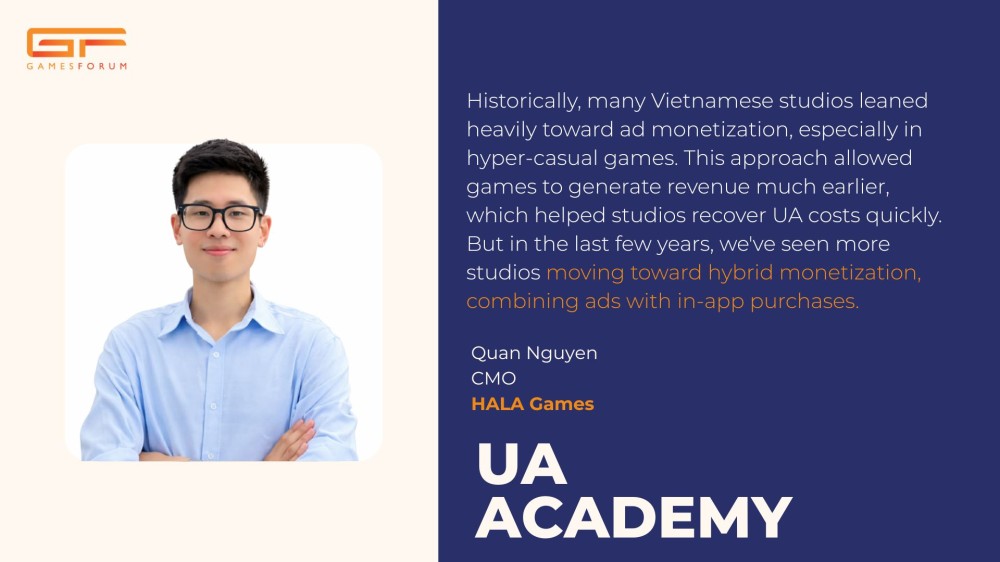
As CMO of Hala Games, Quan Nguyen didn’t start out thinking about big-picture strategy - he was deep in the weeds running campaigns, testing creatives, and chasing performance metrics. Over time, that hands-on UA experience evolved into something bigger: thinking about how to build marketing systems that actually scale. Today, he focuses less on tweaking ads and more on connecting product, data, and creative into a growth engine that drives long-term success.
You progressed from UA roles to Head of Growth and now Head of Marketing. What were the most important skills or mindset shifts required to move from campaign execution to leading marketing strategy?
The biggest shift for me was moving from optimising campaigns to thinking about systems and business. Early in my career, most of my focus was execution-driven: running campaigns, testing creatives, adjusting bids, and analysing ROAS, LTV, RR and so on. The goal was simple - make sure that the campaigns perform better. But as you move into growth or marketing leadership roles, the questions become much broader. Instead of asking “how do we improve this campaign?”, you start asking “how do we build a marketing engine that can consistently scale?”. This requires understanding the full picture - product-market fit, monetisation, creative pipelines, and how UA, product, and data teams work together. You gradually move away from execution towards building strong foundations and shaping the overall strategic direction.
During your time running campaigns across platforms like Meta, Google, TikTok, and Unity, what was the most difficult lesson you learned early in your UA career?
When you're new to UA, it's easy to assume that if campaigns aren't scaling, it's because of targeting, bidding, creatives, or even from the ad network. So you spend a lot of time tweaking campaigns. But over time, you realise that campaign data is often just reflecting what's happening inside the game. If the retention is low, or the onboarding isn’t clear, no amount of UA optimization can fully fix that. That lesson really changed how I approached UA. Instead of seeing it as just media buying, I started treating UA as a feedback layer for the product. That’s why I believe UA needs to be closely connected not only with the creative and idea teams, but also with the product team. If you truly understand the product at a deeper level - how users engage, where friction happens, and what drives retention and monetisation - it becomes a significant advantage. It allows you to not only scale more efficiently, but also contribute to shaping a better product overall.
When you’re optimising campaigns today, which metrics do you prioritize most for decision-making, and how has that framework evolved throughout your career?
Earlier in my career, I focused heavily on short-term ROAS metrics like Day-1 or Day-7 because those were the fastest signals available when running campaigns. Over time, I realised that those numbers alone don’t always reflect the real potential of a game, especially for titles with longer monetisation curves. Today, I tend to look at a broader picture. Retention is usually the first thing I check, because it tells you whether the product is actually resonating with players. From there, I look at the payback window and whether campaigns can realistically reach profitability within a timeframe. Creative performance such as CPI, CTR, IR has also become a much bigger factor in decision-making, because the quality and quantity of creative often determines how far a campaign can scale. So the framework has evolved from focusing mainly on short-term ROAS to understanding the overall relationship between product quality, monetisation potential, and creative efficiency.
You’ve worked closely with product and data teams on launch planning and scaling. What does effective collaboration between UA, product, and analytics teams actually look like in practice?
The best teams treat UA as more than just a marketing function. It’s really a real-time feedback system for the product. Before launch, UA can help validate the game's positioning by testing creatives and running small campaigns. Sometimes the ad performance already tells you whether the game’s core idea resonates with players. Once the game starts scaling, the collaboration becomes even tighter. UA teams bring insights about player acquisition, analytics teams model LTV and cohort behaviour, and product teams adjust the game based on those signals. When that loop works well, improvements happen much faster because everyone is reacting to the same data.
You’ve worked on optimising both user acquisition and in-app advertising performance. How do Vietnamese studios typically approach the balance between scaling installs and maximising ad monetization?
Historically, many Vietnamese studios leaned heavily toward ad monetization, especially in hyper-casual games. This approach allowed games to generate revenue much earlier, which helped studios recover UA costs quickly. But in the last few years, we've seen more studios moving toward hybrid monetization, combining ads with in-app purchases.Casual and puzzle games often rely on rewarded ads and interstitials, while mid-core games lean more toward IAP. The tricky part is always the same: finding the right monetization without hurting the overall user experience!
Vietnam has become a major hub for mobile game development and publishing. From your experience, what factors have contributed most to this growth?
There are several reasons behind Vietnam’s growth as a mobile game hub. The country has a strong technical talent pool, with many skilled engineers and game developers entering the industry every year. At the same time, Vietnamese studios have built deep expertise in performance marketing and user acquisition, which has helped them scale games globally even without the backing of large international publishers. Over the past decade, the ecosystem itself has also matured significantly, with more experienced founders, more specialised teams, and greater knowledge sharing across studios. Together, these factors have allowed Vietnamese developers to compete much more effectively on the global stage.
As someone now leading marketing, how do you see the role of UA evolving over the next few years, especially with privacy changes and new attribution models?
UA is gradually evolving from a purely performance marketing role into a broader growth function. With privacy changes limiting user-level data, teams are relying more on modelling, aggregated signals, and first-party data. At the same time, creative strategy is becoming even more important. Many studios are already moving toward “creative factory” models, where they produce and test a large volume of creatives continuously. So I think the role of UA will become more cross-functional. It will involve product insights, creative strategy, and data modelling - not only just focusing on optimizing the Campaigns!

You might also like











Home of the Gamesforum events series and leading mobile game analysis. Discover everything you need to know about mobile games marketing and monetization.