Mobile Executive Summit & The Challenge of Scaling Vietnamese Games Globally
On May 12, Gamesforum will host the Mobile Executive Summit (MES) in Ho Chi Minh City - an event specifically designed for leaders and founders in Vietnam’s mobile game industry. The summit will focus on some of the most pressing topics today, including publishing & co-development, UA funding, investment, and global scaling strategies.
As the Vietnam market enters a transitional phase, shifting from growth driven by production to growth driven by operations and scalability - many Vietnamese studios, despite strong game development capabilities, continue to face significant challenges when bringing their products to international markets. Questions around the “missing pieces” in publishing, data, UA, and liveops are becoming increasingly urgent.
To better clarify these gaps, as well as expectations for MES in connecting and accelerating ecosystem growth, Gamesforum spoke with Trịnh Xuân Hải, who is directly involved in and closely observing the current evolution of Vietnam’s gaming market.
In your opinion, what makes the Mobile Executive Summit particularly relevant to the current context of Vietnam’s mobile gaming industry?
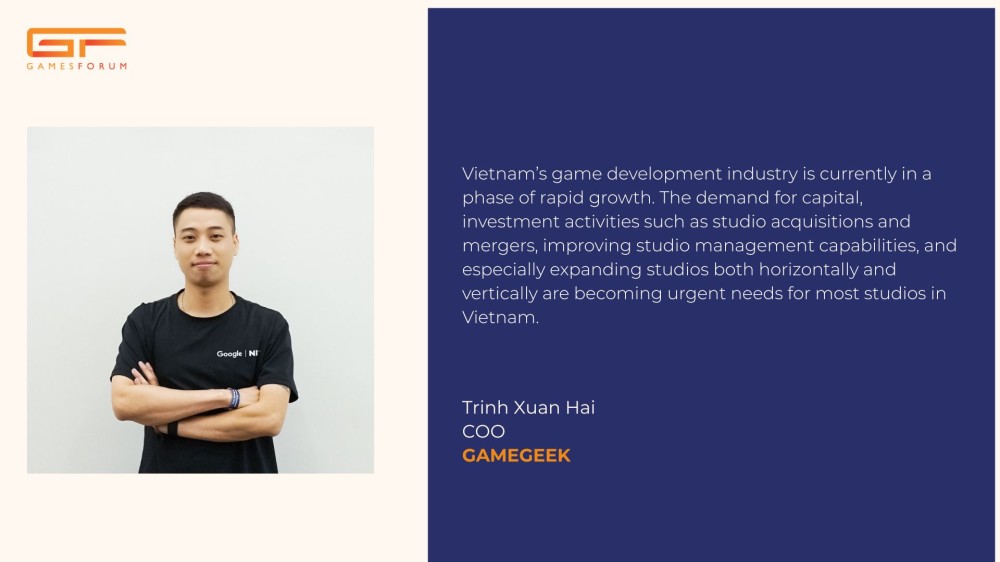
Vietnam’s game development industry is currently in a phase of rapid growth. There is a strong demand for capital, M&A activity, improved studio management capabilities, and especially for scaling studios both vertically and horizontally - all of which are pressing needs for most studios in Vietnam.
At MES, Vietnamese studios will have the opportunity to directly connect with investment funds, consultants, and experienced publishers. This creates a platform to address key questions, resolve development challenges, or simply find the right advisors aligned with their strategic direction.
Many Vietnamese studios have strong production capabilities but struggle to scale globally - particularly in publishing, UA, and Live Ops. In your view, what is the biggest “missing piece,” and how can MES help address it?
This is a difficult question, as it’s hard to define a single “missing piece” applicable to all studios. However, looking at successful studios, there are common denominators: Data, UA, and Live Ops.
- Data: In today’s environment, all decisions should be data-driven. However, not many studios have made structured investments in data teams or implemented micro-segmentation. This leads to less accurate decision-making, sometimes based on incomplete data, resulting in the need to overhaul entire products instead of optimising incrementally.
- UA: UA is largely a capital-intensive game. Without sufficient budget or a clear strategy, it is very difficult to compete at a global scale.
- Live Ops: This is arguably the largest gap for many Vietnamese studios. Games need to be operated as “living ecosystems” with events, personalized offers, and monetization triggers. Without this, the experience remains limited to daily login and play, lacking depth and engagement.
MES is expected to help narrow these gaps by sharing practical insights from international publishers and studios - particularly how they leverage data, make decisions, test, and optimize at each stage of scaling.
Funding, M&A, and co-development are gaining attention in Vietnam. What is driving this trend, and what mindset should founders adopt?
This trend is driven by several factors:
- The maturation of the ecosystem: Vietnam’s gaming industry is growing rapidly and is increasingly recognised as a new production hub with strong execution capabilities.
- Rising competition: Scaling independently is becoming more difficult without additional resources or the right partners.
- Studio maturity: Vietnamese studios are shifting toward building sustainable businesses rather than focusing on individual game products.
Additionally, the supporting ecosystem - including payment systems, financial advisory, and investment funds - is developing rapidly, enabling more structured and efficient funding, M&A, and co-development activities.
In terms of mindset, three key elements stand out:
- From “survival” to “synergy”: Collaboration should not be seen as a temporary solution, but as a way to optimize resources and create greater value.
- Global standards: Transparency in finance and legal structures is essential when working with international partners.
- Cultural flexibility, core strength: Founders must adapt to international operating models while maintaining their core strengths to become strategic partners - not just outsourcing vendors.
If MES is viewed as a “connection platform,” what needs to happen to create truly valuable partnerships after the event?
For MES to function effectively as a connection platform, several factors are critical:
- Participation from the right people - decision-makers from both Vietnamese studios and international publishers or funds.
- Practical case studies that demonstrate real-world problem-solving.
- Transparency in needs - each party must clearly understand what they offer and what they are seeking, allowing discussions to be direct and meaningful rather than superficial.
Additionally, co-creation workshops where participants collaboratively solve specific problems - can build trust more quickly than traditional networking.
Finally, the presence of “catalysts”, credible experts or connectors, plays a key role in driving relationships forward.
The value of partnerships can be summarized as:
Partnership = (Trust + Real Needs) × Follow-through Mechanism
When founders are willing to share their real challenges, and partners provide concrete solutions rather than promises, that is when an event can generate long-term value.
You might also like









Home of the Gamesforum events series and leading mobile game analysis. Discover everything you need to know about mobile games marketing and monetization.